

Hershey (Christian Movie Review)
There’s nothing bitter or unsavory in this mix; sentimental, wholesome, and as sweet as milk chocolate, Hershey is a conventionally told but relentlessly feel-good love story and uplifting drama.
About the Film
You’re hopefully familiar with the delicious taste of Hershey’s chocolate, but what about the rags-to-riches, romantic love story behind the tasty treat? Seeing Hershey chocolate displayed at every grocery store check-out line may seem inevitable today, but the creation of chocolate was once a risky and almost reckless endeavor. Hershey is the story of that creation, and the inspiring men and women behind it. There’s nothing bitter or unsavory in this mix; sentimental, wholesome, and as sweet as milk chocolate, Hershey is a conventionally told but relentlessly feel-good love story and uplifting drama.
Now, there’s sure to be some eyebrows raised whenever a company or estate is involved in the creation of a biopic. The Hershey Company was heavily involved in the financing and production of Hershey, which lends the film an unavoidable degree of commercial propaganda. Thus, it’s unsurprising that Hershey is shown to be a company governed by outstanding virtue and values, with a product unlike anything else on the market! Yet, this is still a movie about chocolate, and so it’s difficult to be too cynical. And by all accounts, Milton Hershey was indeed an upstanding and virtuous man. There are no skeletons in any closets here; just plenty of tasty chocolate.

Hershey is exactly the type of movie that it wants or needs to be. Hershey (the man) is shown to possess an almost reckless and impulsive entrepreneurial spirit, but Hershey (the film) plays it unwaveringly safe and unchallenging. There’s no risk taking here. Every ingredient seems meticulously chosen to make audiences feel good. The unrelenting wholesomeness of the film strips the story of much of the drama and narrative tension but also makes it more palatable and easily digestible for audiences merely looking for undemanding, escapist drama. After all, we don’t eat chocolate because we want to think deeply or have our worldview attacked—we devour it because we want to feel good.
As a film, Hershey doesn’t do anything exceptional, but neither are there many areas that it doesn’t at least do well. The visuals are mostly uninventive, but it all has a very satisfying, nostalgic glow to it. The film also shows effective restraint in its dialogue, often allowing the story to unfold visually, which I appreciated. Finn Wittrock as Milton Hershey, and Alexandra Daddario as Catherine “Kitty” Hershey both give solid performances and have good chemistry, even if neither stands out or is given much opportunity to take their characters to a deeper or more dramatic place.

The film has a wholesome message to share about being a pocket of joy and hope amid a challenging world. Angel Studios (the distributor of the film) recently made headlines for clarifying its identity as not an exclusively religious company, but rather, focusing on “values-driven storytelling that amplifies light, celebrates hope, and inspires the moral imagination of viewers.” Hershey is a clear example of that commitment. Other than one moment of Milton voicing a desperate prayer, there’s no overt focus on faith or religion (the real Milton Hershey was raised in a religious household, but as an adult, his faith was primarily driven more by practical acts of love and kindness). Even so, Christian values and morality permeate the film from start to finish.
While the film’s message is timeless and agreeable, its impact is somewhat muted. The film falls into the same trap as many biopics, merely checking off events in historical chronology rather than focusing on a unified thematic thread. Hershey is more an informative account of Milton Hershey than it is an overly interesting character study of him; a film more about the what than the why. We repeatedly see his displays of goodness, but not the internal motivation behind those commendable acts. Hershey is presented as a man with an already formed morality and worldview, and the story lacks enough tension to truly put his worldview to the test.

Part of the issue is that the film follows too many threads, resulting in some getting lost in the mix. The film wants to trace the rise of the business, his romance with Kitty, and his humanitarian efforts (particularly leading to the founding of the Hershey Industrial School). Each thread is compelling, but incomplete. The heralded romance mostly takes a backseat following the marriage, and his business rival is too absent in the story to make for a compelling antagonist. The film gives special attention to the school in the end credits, but in the film itself, that thread feels mostly like an afterthought. A less is more approach would have served the story better, but let’s be honest, I suppose such thinking is rarely one associated with chocolate.
In the end, Hershey is an enjoyable drama, if ultimately a forgettable one. It’s a film so unrelentingly wholesome that it will disarm any cynicism about its shortcomings or commercial connotations. I enjoyed the film more than expected, not because it was exceptionally crafted, provocative, or intellectually stimulating, but simply because it made me feel good. It’s all just so relentlessly sweet, and like popping a Hershey’s Kiss into the mouth, sometimes all we want is just a small dose of a comforting treat.
For Consideration
On the Surface—(Profanity, Sexual content, violence, etc.).
Language: There is 1 mild profanity.
Violence: None.
Sexuality: There is some relatively tame flirtatious banter between a husband and wife, including her licking a spoon of chocolate in what may be perceived as a provocative way, or beginning to disrobe as she leaves the room, as an invitation for her husband to join her in the bedroom.
Engage The Film
Spreading Joy
Most people find some degree of happiness by indulging in chocolate on occasion. What Hershey demonstrates is how that experience was an extension of a life that took pleasure in spreading light and joy in the middle of a difficult and challenging world. According to the film, Milton Hershey was a man who found pleasure in dispensing joy. Some of the most impactful scenes are when a young Milton, working as an assistant at a local candy shop, brings home new candies and treats to his family around the dinner table, and relishes in the delight on their faces.
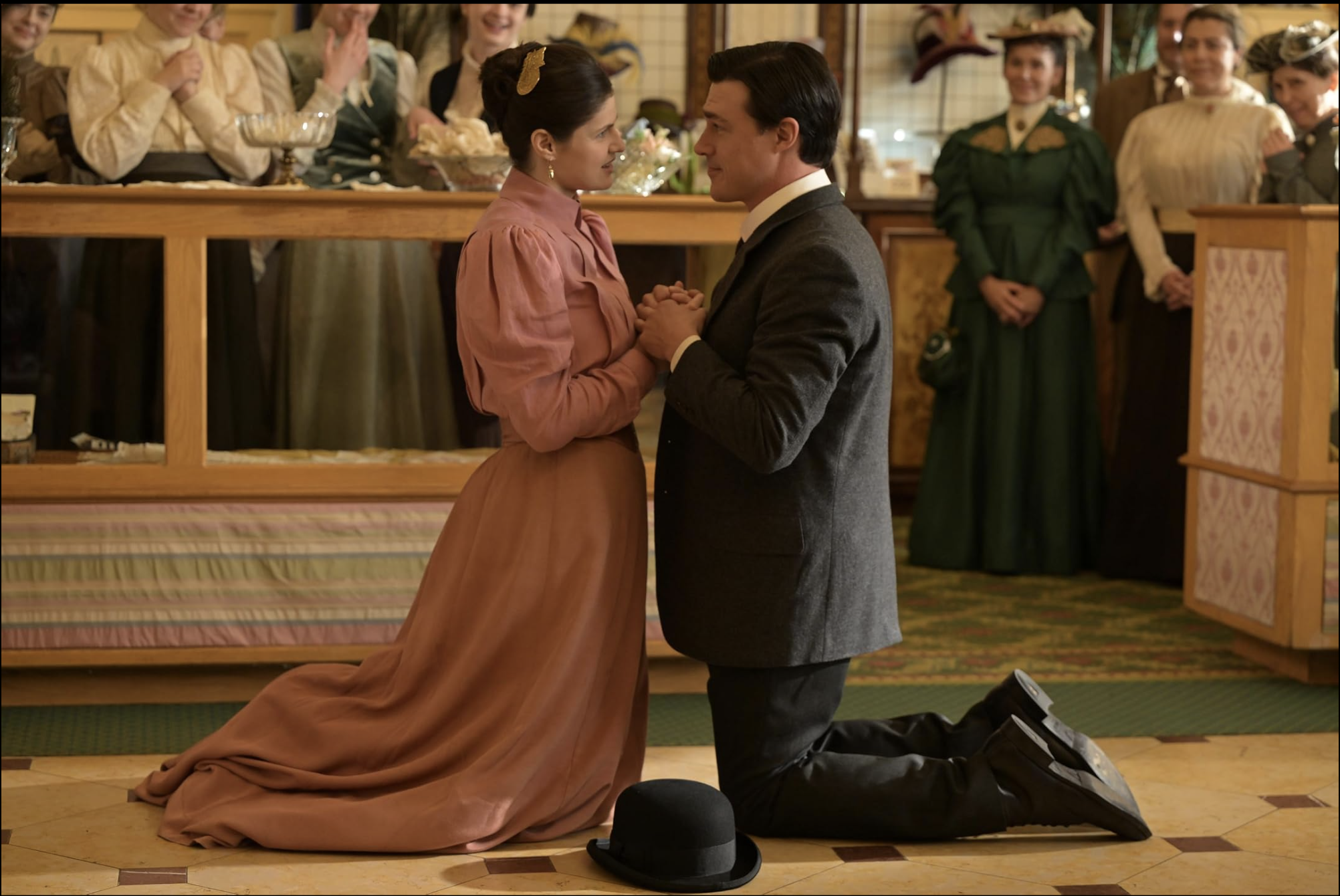
Whether it was caring for orphans, or being a blessing to his wife, or acting in a counter-cultural way to respect the dignity of the workers at his company, Milton demonstrates a people-first mindset. At one point, he remarks, “If the community thrives, the business thrives.” Throughout the film, his financial advisors repeatedly caution him about the cost of such acts of charity and goodwill, but Hershey’s conviction is clear—kindness and joy are priceless, a gift of incalculable worth.
The Bible says, “Whoever brings blessing will be enriched, and one who waters will himself be watered” (Proverbs 11:25). Milton Hershey’s life was not without hardship and sorrow—death of loved ones, abandonment from his father, and the pressures of business—but it was a life filled with blessings, both received and shared. His personal story, whether starting the Hershey Industrial School or building an entire town to benefit his workers, may be unique and extreme. But as the film demonstrates, sometimes simple acts of kindness can go a long way.


